General
10 Jan 2006

Ancient parts of a comet to land in Open University lab

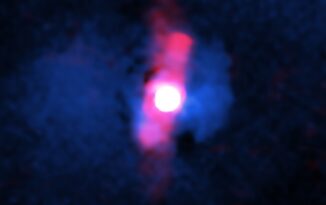
Comet Wild 2 (NASA image)

Comet Wild 2 (NASA image)

Before the end of January particles from a distant comet will be delivered to The Open University and research will begin on what could be keys to the origin of life in the universe.

NASA’s Stardust mission is returning to Earth early January 15th after a three billion-mile (4.6 billion-km) trip to collect interstellar comet dust from Comet Wild 2 (pronounced vilt after the Swiss man who discovered it). During a brief encounter with Comet Wild 2 nearly two years ago, Stardust captured thousands of particles as it came within 146 miles (240 km) of the comet, surviving the high speed impact of millions of dust particles and small rocks up to nearly half a centimetre across. Stardust’s tennis racket shaped collector captured thousands of these comet particles into cells filled with Aerogel-- a substance so light it almost floats in air.

The samples are returning to Earth in a capsule that will parachute into the Utah desert, the first sample-return mission to a comet. The first samples will be made available to a small number of teams, including The Open University’s Planetary and Space Science Research Institute (PSSRI), for preliminary analysis before their release to the wider scientific community.

A team from The Open University including Dr Simon Green, Dr Ian Franchi, Dr John Bridges and Professors Tony McDonnell and Monica Grady will be among the world's first scientists to analyse the samples that contain the fundamental building blocks of our Solar System. Analysis may be able to determine not only the origins of the Solar System from these samples, but also possibly the origins of life.

“Stardust could provide a new window into the distant past,” said Dr Green. “Comets are made of ice and are very cold and have been very cold since they were formed, so they haven't been changed since the beginning of the formation of the Solar System. So we have almost a little time capsule of what things were like 4.5 billion years ago. We can also learn about processes in stars and interstellar dust clouds in which the dust grains originally formed. They may also reveal information about the origins of life since comets are a source of organic material that may have formed the original building blocks of life-forming molecules."

PSSRI involvement in this mission covers a number of areas:
• The design and provision of sensors for the Dust Flux Monitor instrument and measurement of dust impacts at the Wild 2 encounter
• Members of the dust coma modelling team
• Development of sample extraction and characterisation techniques in Aerogel.
• Members of the Preliminary Examination Teams for sample analysis.

Particle Physics and Astronomy Research Council

Particle Physics and Astronomy Research Council

Professor Keith Mason, Chief Executive Officer of the Particle Physics and Astronomy Research Council (PPARC), which part funded the UK involvement in Stardust, said, “The return of the samples from Stardust is a truly remarkable feat. It will be the first time in the history of space exploration that samples from a comet will be returned to Earth. It is particularly exciting that the Open University team will be one of the first to analyse the samples – helping to further our understanding of the origins of the Solar System.”

Editor’s Notes
NASA Broadcast Information
The capsule is set to return to the Utah Desert at 3.12 am MST on 15th January (10.12 am GMT).
There are plans for the following NASA media activities:-
Thursday 12th January – a NASA TV aired media briefing (from US Army Dugway Proving Ground) at 10 am MST (5pm GMT)
Sunday 15th January - live Coverage of the return event will be aired on NASA TV from 2.30 am – 4 am MST (9.30 am – 11 am GMT).
Sunday 15th January - live post return media briefing will be held at the US Army Dugway (and aired on NASA TV) at approximately 7 am MST (2pm GMT)


Dr Green and other members of the team are available for expert comment on Sunday, 15 January.

back to All News stories

back to previous page

back to top